01 – The Premise
For five centuries, Western painting has assumed a classical universe. The subject exists. The artist records them. Light bounces off a face and lands on a canvas. This is the physics of Newton, and it is incomplete.
Quantum mechanics demonstrated a century ago that reality at the most fundamental level does not behave this way. Unobserved, light travels as a wave, spread across every possible path at once, a distribution of where it might be rather than where it is. Observed, it collapses to a particle, a single point, a fact. The observer does not passively receive the world. The observer participates in constructing it.
Yet few painters have taken this seriously as structure rather than subject. Not as metaphor. Not as illustration. As the actual structural basis for how a painting is built.
Observerism begins here: if observation creates reality, then painting is not recording. It is an act of creation.
02 – The Double Slit, Rotated
Everyone knows the double slit experiment from the side. A light source, two slits, an interference pattern on a detection board. Unwatched, the light passes through as a wave and lands as interference. Watched, it passes through as a particle and the interference disappears. It is the most reproduced diagram in physics. But it is rarely asked what it looks like from the front.
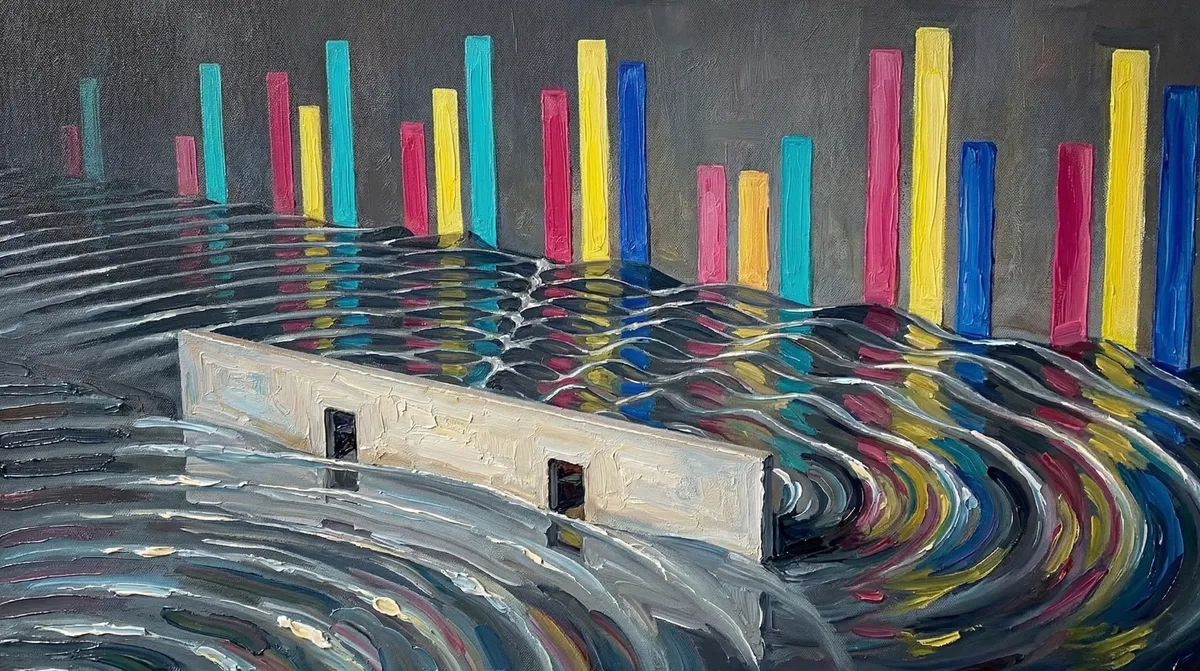
Imagine standing at the detection board, facing the slits. The beam travels directly toward you. You are the observer. You are the measurement apparatus.
Physics does not require the observer to be conscious. A detector will do. Observerism takes the participatory reading anyway, knowingly, because painting is the one place where the observer is always a person.
At the point of your focused attention, your conscious gaze, the wave collapses. You see a definite thing. A face. A hand. A particle. This is the centre of the painting: sharp, present, resolved.
But your peripheral vision has not observed the rest. The surrounding field remains uncollapsed. Still a wave, still a distribution of possibility. Expanding circles of likelihood radiating outward, becoming less definite the further they sit from the point of conscious focus.
This is what an Observerism painting depicts. Not a subject in a setting. An observation event. The centre is the collapsed particle state, the thing you chose to see. The periphery is the wave state, everything your gaze has not yet resolved into certainty.
The circles and orbital forms that fill the space around the subject are not abstraction. They are the probability field of the uncollapsed wave, painted as it would appear if you could see superposition directly.
03 – The Hidden Light
Standard light, the light we see, the light that collapses into particles on our retina, travels in flat, planar wavefronts. But there is another kind of light.
Some light travels twisting, its wavefront spiralling through space like a corkscrew. The tighter the twist, the more the light's energy is pushed away from the central axis, and at the very core of the beam there is nothing. A dark vortex. The light is there, but it cannot be detected at the point of observation.
Observerism takes this as an image for the limits of observation itself. Some information is structured in a way that resists collapse, that spirals around the point of measurement without ever landing on it.
There are aspects of a person, of any subject, that observation can never resolve. Not because we lack the tools, but because the information itself is structured to evade direct detection. It is present. It is real. It is dark.
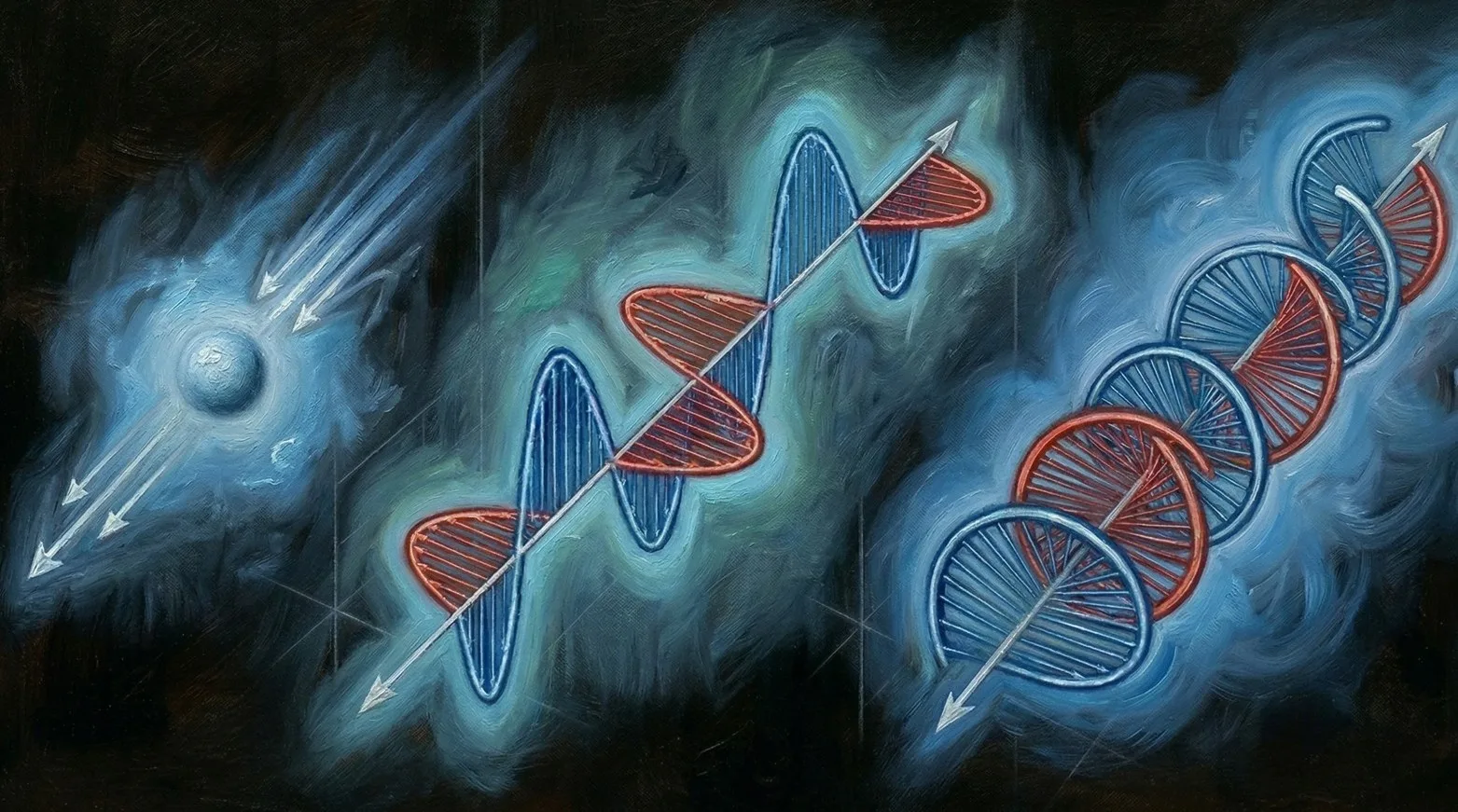
The spiralling forms in an Observerism painting carry this meaning. They are the twisting light around the subject, carrying what cannot be observed head on. The things about a person that resist being known, that exist in the gap between what is seen and what is there.
04 – Five States of Observation
Observerism organises its practice into five categories, each corresponding to a physical state in the quantum description of light and matter.
I. The Particle
The collapsed state. Maximum certainty, minimum ambiguity. The subject rendered with forensic clarity, every pore, every crease, every definite fact of a face. This is what the observer's full attention produces. The portrait as measurement.
II. The Wave
The uncollapsed state. The subject exists as a distribution of possibility, present everywhere, definite nowhere. These works dissolve the figure into interference patterns, standing waves, and fields of likelihood. The portrait before observation.
III. The Transition Region
The space between particle and wave. Where the most interesting paintings live. The subject partially collapsed, partially probabilistic. Sharp focus bleeds into orbital uncertainty. Observation is incomplete. The portrait mid measurement.
IV. The Hidden State
The twisting light. Information that is present but structurally hidden from observation. These works explore what spirals around a subject without ever being directly seen. The carried but unresolvable aspects of identity, history, and interior life.
V. The Sovereign Observer
The self portrait. The observer turned inward. When the apparatus measures itself, the collapse becomes recursive. The act of seeing creates the seer. These works interrogate what happens when the observer and the observed are the same entity.
05 – The Construction
The circles and spirals are not placed by eye alone. Their positions come from a rule, and the rule comes from the physics of twisting light.
The visual structure of every Observerism work, the distribution of clarity and ambiguity, the placement of orbital forms, the relationship between centre and periphery, is derived directly from the physics of observation. The paintings are built the way waves behave. The circles have radii governed by probability. The spirals follow the paths twisting light actually takes. That is a checkable claim, so here is the construction.
The geometry comes from the physics. The painting comes from the hand.
Every painting is an observation event. The canvas is the detection board. The viewer completes the experiment.
The Scientist Series
Observerism finds its most complete expression in portraits of scientists whose research directly concerns the nature of observation and measurement. Each portrait collapses a different scale of reality into the focal zone while rendering the subject's research domain as the wave geometry of the periphery:
Science policy as the national measurement apparatus
The SABRE experiment: observation at the scale of dark matter detection, a kilometre underground
The accelerating universe: observation at the largest possible scale
The series embodies the central claim of Observerism: the act of looking is not passive reception. It is the constitution of reality. The painting is incomplete without the viewer. The canvas is a field of structured possibility waiting for a conscious observer to determine which part becomes fact.
Applications
Observerism applies its formal structure across four domains of practice:
Portraiture
The Scientist Series. Large format portraits where the subject's domain becomes the wave geometry of the periphery.
Landscape
The Australian landscape as observation event. Land and atmosphere dissolve into orbital geometry at the periphery.
Institutional
Portraits for universities, research institutions, and corporate collections. Connecting institutional legacy with contemporary physics.
Commission
Bespoke Observerist works developed in consultation. The transition boundary treatment is unique to each subject.