Samuel Morrow
Building designer and painter. The whole practice lives in the gap between those two things.
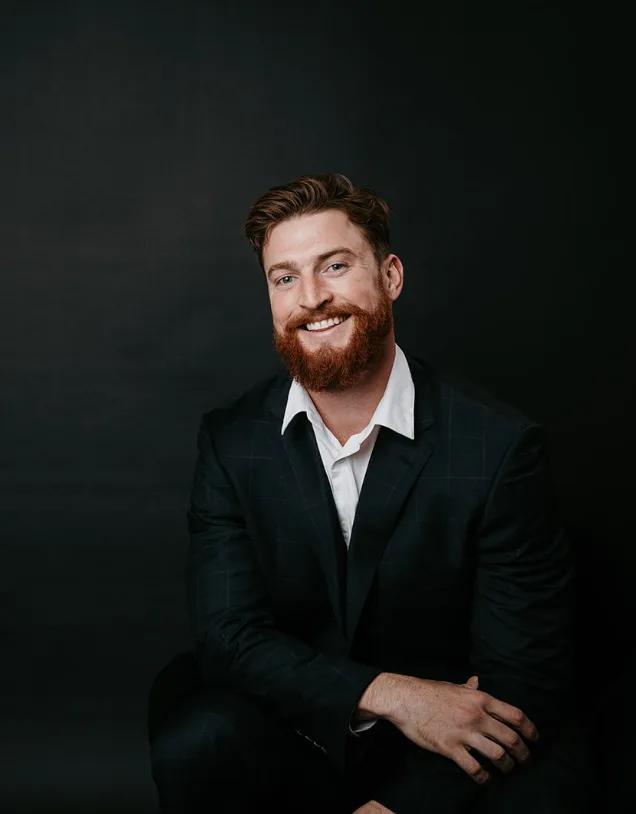
I trained in building design, and I work in Sydney as an architectural lead. That's where I learned to be precise about light and structure. The physics came later, on my own, and it wouldn't leave me alone. Observerism is what happened when I stopped trying to keep the two apart. The middle of every painting I render as real as I can. The edges open up into the actual structure of light, the wave that hasn't been looked at yet.
The Scientist Series is the heart of it. They're portraits of people who've spent their lives looking at what can barely be seen. The first one, of Dr Alan Finkel, Australia's former Chief Scientist, went to him and stayed there. The founding work of the whole movement now hangs with the man who sat for it. Since then I've painted Professor Elisabetta Barberio, who hunts for dark matter a kilometre underground for the University of Melbourne, and Professor Brian Schmidt, the Nobel laureate at Mount Stromlo who found that the universe is flying apart faster and faster.
Diploma of Building Design
Building designer, working in Sydney as an architectural lead. The discipline behind the precision about light, structure and space.
The Finkel acquisition
The Observer of National Science, the founding work of the Scientist Series, acquired by its subject, Dr Alan Finkel AC, former Chief Scientist of Australia, along with its study.
The series grows
Portraits of Professor Elisabetta Barberio and Professor Brian Schmidt AC completed, painted from sittings at the Stawell Underground Physics Laboratory and Mount Stromlo. Two Australian landscapes join the catalogue.
Institutional placement
Both available Scientist Series portraits are offered for institutional acquisition or long-term loan. Further portraits in the series are planned for 2027.
I paint what physics describes but can't quite show you.
The sharp part of each painting is the world that's been looked at. Real, present, decided by your attention. The edges are the world that hasn't been looked at yet, the wave still open, painted as the real structure of light rather than blurred away. And the line between the two is your own looking, the place where a maybe turns into a fact.
My Scientist Series puts that idea around people whose whole working lives are about observation. One looked after a nation's idea of knowledge. One hunts for invisible matter underground. One looked out to the edge of the universe. Around each face, the periphery carries the particular thing that person spent their life trying to see.
These aren't illustrations of quantum mechanics. I use its structures the way a painter uses anything, as a language to make something beautiful and true. I call it Observerism because the painting isn't finished without you. You're the observer. Your looking is what decides which part of it becomes real.
Visit the studio, or write
The studio is in Surry Hills, Sydney. Studio visits are welcome by appointment.
Get in Touch